Nee Sern is...

really really sleepy

Thursday, October 06, 2005

Examples of Pink Elephants

Recently, MITI minister Rafidah Aziz had been committing many Pink Elephant slips, evident in her various responses regarding the AP issue.

The latest example from the interview excerpt in New Straits Times:

And, so far, the Prime Minister has said nothing less than full support for what I am doing. For this I am very very happy and (it) has motivated me to even work harder. I say this not to "mengampu" the Prime Minister.
DUHH!!!

How about when she was asked to release the list of AP receipients at the time when it was still clouded in secrecy?

Release! Release all! We have nothing to hide!
DOUBLE DUHH!!!

How many more pink elephants can you spot in your daily observations?

Be known!

My manager had this to say during our team meeting:

It's no good if you're excellent at your job but nobody knows.
Refreshing thought indeed!

Excellent employees jump up the value chain simply because they are able to prove to the superiors that they are valuable and capable of handling greater responsibilities.

Mediocre employees are content to do the job right and be happy with that.

While, sneaky employees rather not do any work but claim all the credit.

The point is... it's not enough to only be working in your own team and be very good at what you do. We have to constantly build the inter-departmental relationships with the managers of the other teams, to be well known and recognized, to be sought after should we decide to focus on a different job scope!

Branding i.gemz ...

Who are i-GemZ?

A collection of singers and songwriters who have expertise in performing on stage?

A group of musicians who frequently practice and have performances often?

A few songwriters who employ professionals to sing their songs?

Recording artists?

A Buddhist choir?

Unveiling the new (proposed) i.gemz typeface!

What is i.gemz brand promise?

-> Young and Vibrant
-> Spiritual
-> Contemporary
-> Reaching Out

((MORE TO COME))

Friday, September 30, 2005

Do you need to be a good swimmer in order to be an excellent swim instructor?

Do you need to be a good swimmer in order to be an excellent swim instructor?

Think about the statement above. Does a badminton coach have to be a good badminton player?
Does a manager of the procurement team have to be well versed in the procurement softwares and procedures?

Does the CEO of a major multinational airline have to have the working experience in the airline industry?

Top management frequently deals with concepts and ideas rather than the actual details of each segment of the organization. For that they have their managers to ensure that their vision is cascaded downstream to the working level.

But in order for the top management to succeed in the arena, he needs to have a sound conceptual view of his own industry. For example, Tony Fernandez knows nuts about operating an aircraft, let alone an airline business! He came from a background operating a radio station business. And yet today he is one of the most successful entrepeneurs in Malaysia. He may not know the intricacies of the business, but he has enough savvy to translate time-tested principles of business and management into any industry.

Back to the original question. If a swim instructor does not know how to swim, will you trust your children with him? He may have the conceptual knowledge of how to swim, the theoretical background of each swimming style, the technicalities of treading water, etc. But will you prefer that over someone who has actual experience of swimming in water, actually practicing all the techniques rather than keeping it all in his head?

The new CEO of Malaysia Airlines comes from the Oil and Gas industry. Will he be able to adapt to the airline industry? Again, if the time-tested principles are the same in both industries, he will be able to adapt to the business and generate revenue and profit, at the same time maximizing the EBIT and minimizing OPEX, providing maximum returns to shareholders and investors.

So, do I have to be very good in GSM/GPRS/EDGE/UMTS/WIMAX before stepping up the ladder to become a manager?

I read in one book (THE RULES OF WORK) that before becoming too ambitious, one must be good at what one does first. Only with the proper credentials can one then move on. I tend to agree with this statement, because although it's true that managers do not need to know the technicalities, but it is an advantage for managers to know the technical aspects of the business because it provides him with first hand knowledge of the potential issues that may arise in the team that he manages.

Comparing a manager who is strictly about managing people, and a manager who additionally possesses the technical know-how, I feel that it's the latter that has the advantage when it comes to effective management of situations.

Alex, thanks for the trigger.

Tuesday, September 27, 2005

A night of Double Take!

I now have the highest respect to the gentleman named Roger Wang, the guitar maestro of the energetic and highly talented jazz duo Double Take. With the lovely Mia helming the vocals, displaying the superb mastery of the art of light jazz, Double Take enthralled us in the Cotton Club in Maju Junction.

Thanks Daniel for the invite!

(Mia and Roger Wang - Double Take - 3rd and 4th from the left)

Incidentally, it was also the night of Malaysian Idol results. Despite that, the club was packed with fans and music lovers of all ages. Double Take performed a wonderful collection of songs from around the world, and also several instrumental pieces that really jive up the spirit of music making.

Roger's mastery of the instrument is astounding. His deft fingers slid across the fretboard with much fluidity and grace, and his right hand displayed the amazing control and improvisation to realize the most unique guitar sounds ever produced on a standard 6-string!

It's amazing, that a six-stringed instrument can be used to do so many things. And it's the joy of discovering these hidden potentials of the guitar that make it such an interesting instrument to learn.

Double Take, made in Malaysia, all the best to you!

Friday, September 23, 2005

The story of 24IDC logo

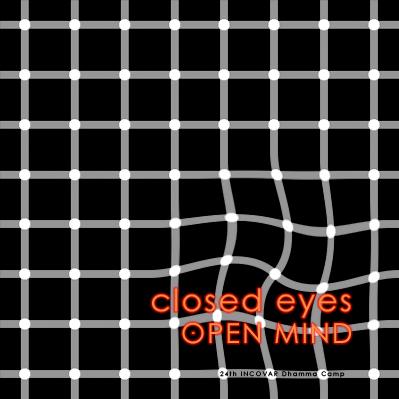
This is one of the drafts of the logo for the 24th INCOVAR Dhamma Camp


This is an optical illusion known as the Hermann Grid. It is a repeating pattern of bright criss-cross lines over a black background, with prominent dots at the crossing points. As you view the illusion, you notice that the dots will alternate between dark and bright.

The Hermann Grid is used to illustrate how worldly stimuli can cause you to form wrong perceptions about the world. Although the reality is just a pattern of lines and dots, the net effect on your eyes is that it "shimmers", and therefore causes much discomfort and uneasiness.

To better appreciate the pattern, it is important to be able to tap into the greater consciousness through mindful practice and meditation. Hence, by closing the outer eye, the inner eye (i.e. the mind) is opened, allowing the true nature of things to be seen.

The distorted section of the logo on the bottom right corner illustrates the power of the mind in reshaping preset perceptions and wrong views. The dot in the middle of the O in OPEN MIND represents the awakening of the inner eye.

Closed Eyes, Open Mind.

Wednesday, September 21, 2005

Planned spontaneousness

Have you ever attended any seminars where the speakers are so eloquent and confident in their presentation, they seem to be able to pluck ideas from the sky whenever they need it in their speech?

You will be amazed at how spontaneous they seem to be on stage, as if they are making things up as they go along.

But have you ever considered that perhaps the speaker planned in advance to look and sound spontaneous?

When I attended the NLP training, initially I was very overwhelmed by how spontenously the trainer was able to bring up relevant stories and anecdotes to support his arguments and points. The various jokes, examples and games that he presented seemed to have been thought of at that moment itself when he was presenting the points.

Then, later on, I caught up to his tactics. He was trying to manipulate the psychology of the participants. By presenting himself as someone confident who knows anything and everything from the back of his hand, the participants are more willing to accept his point of view. And he is able to drive through the message that the mind is greater than the body, with his pre-planned set of games, messages and phrases.

To be able to speak spontaneously is a valuable asset especially when it comes to initiating conversations with clients, presenting key points in your business case (in this example, you will come across as someone who is very familiar with your product or service, and hence the best possible person to deal with). In fact, impromptu speaking is given the name of Table Topics in the well-known Toastmasters International club.

By practicing the art of planned spontaneousness, you will need to reach an awareness level of 4 (unconscious competence), where you do not need to search your memory banks for the answers. If someone asks you your name, you do not need to pause and think how to answer; instead, you immediately provide your name.

This is the spontaneous response that should be honed by a presenter or speaker to be able to drive your message through more effectively and convincingly.

Friday, September 16, 2005

Good morning!

Have you ever listened to a speech, attended a seminar, or participated in a lecture, where the speaker mistakenly greets his audience "Good morning" in the middle of the afternoon or night?

You begin to wonder if the speaker's credentials are waning, or if his awareness in his surroundings are fading. You begin to wonder how could such an intellectually sound person allow such a simple mistake to happen.

And the speaker has succeeded...

Succeeded in what?

He has successfully captured your attention.

Have you ever thought that maybe the speaker deliberately chose to use "Good morning" instead of "Good evening" or "Good afternoon"? By hearing something unexpected, the audience experiences a moment of truth, where they are able to connect with the speaker. The speaker, fully utilizing this moment, builds immediate rapport with his audience, and thus whatever contents of his presentation will be well received by his audience.

So, the next time you are required to speak to a crowd, try this "surprise" technique to build rapport with your audience and establish a comfortable and informal atmosphere throughout your speech. You will be well remembered as a confident and friendly speaker.

What are your thoughts?

*Gary, thanks for this trigger.

Thursday, September 15, 2005

DON'T THINK OF A PINK ELEPHANT!!!!!

...
...

...
...

What are you thinking of now?

The power of negativity

How often do you tell yourself every day:

  • I am so tired
  • I have no strength
  • I am so lazy
  • I don't feel like working
  • I feel sick
Have you ever considered the power of negativity?

Negative energy has a way of creeping into your life. No matter how many positive things you do or say, all it takes is one negative statement to ruin your day.

Why is this?

In simple arithmetical illustration:
(+1) x (-1) = (-1)
(+100) x (-1) = (-100)
(+10000) x (-1) = (-10000)

If you allow negativity to invade your life, you will begin to feel the negative energy slowly filling up to the brim of your body and mind. And because this negativity is so destructive, it outweighs all the positive energy that you've accumulated in your life.

So we should try to get rid of all our negative energy. How? By the power of double negatives!

(-1) x (-1) = (+1)

Does it work?